Mass Soil Mixing
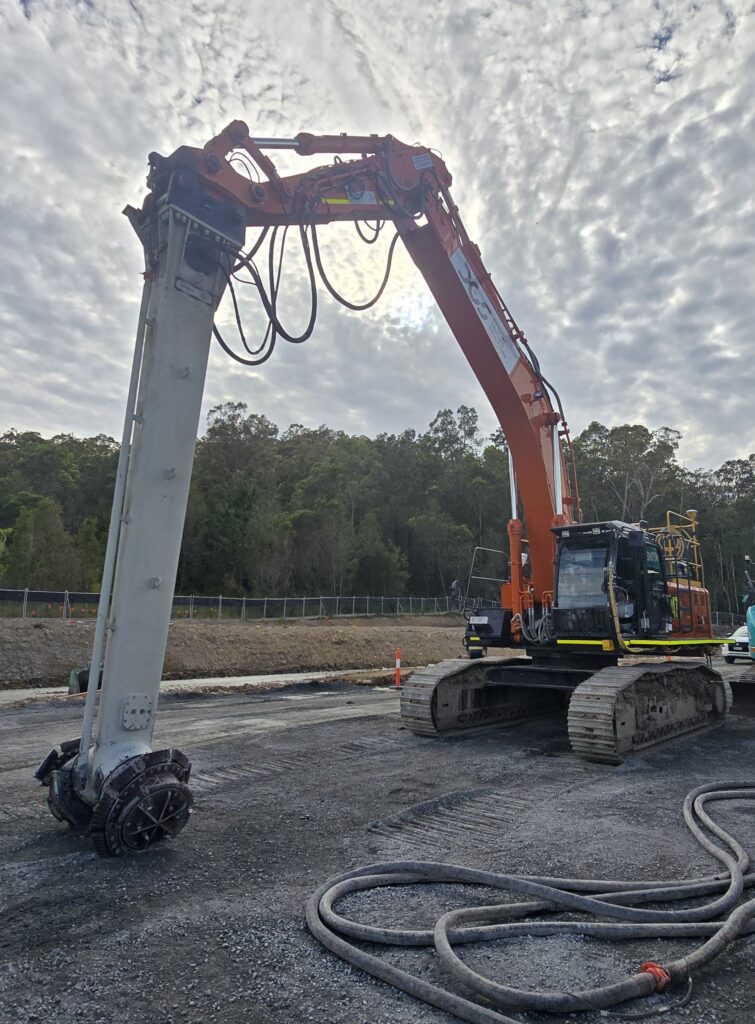
Mass soil mixing is a ground improvement technique that uses large-diameter mixing tools to mechanically blend in-situ soils with a cementitious binder to create a stabilised layer or block. Unlike column-type deep soil mixing, mass mixing treats soils continuously across an area to achieve uniform strength, stiffness, and reduced compressibility.
DGSA uses advanced mixing technologies including high-torque rotary tools, jetting systems, and air injection to improve mixing uniformity, reduce binder consumption, and increase production rates.
The process involves lowering a mixing tool into the ground, injecting binder in powder or slurry form, and mechanically blending the soil and binder until a homogeneous, engineered soil matrix is achieved.
Mass soil mixing is used to treat broad areas of weak or inconsistent ground where excavation and replacement are impractical, costly, or environmentally unsuitable.
Foundation Support
Uncontrolled Fill Treatment
Road & Rail Support
Embankment Stabilisation
Liquefaction Mitigation
Environmental Control
Mining & Industrial Use
Excavation Pits
Mass soil mixing is one of the most efficient and cost-effective methods for treating large areas of weak or variable soil. DGSA’s advanced mixing technologies, binder optimisation expertise, and strong QA/QC systems ensure consistent, reliable, and economical results.
DGSA integrates mass mixing with other ground improvement methods such as dynamic compaction, deep soil mixing, vibro techniques, and compaction grouting to deliver tailored, high-performance ground improvement solutions for a wide range of project requirements.
Our Clients